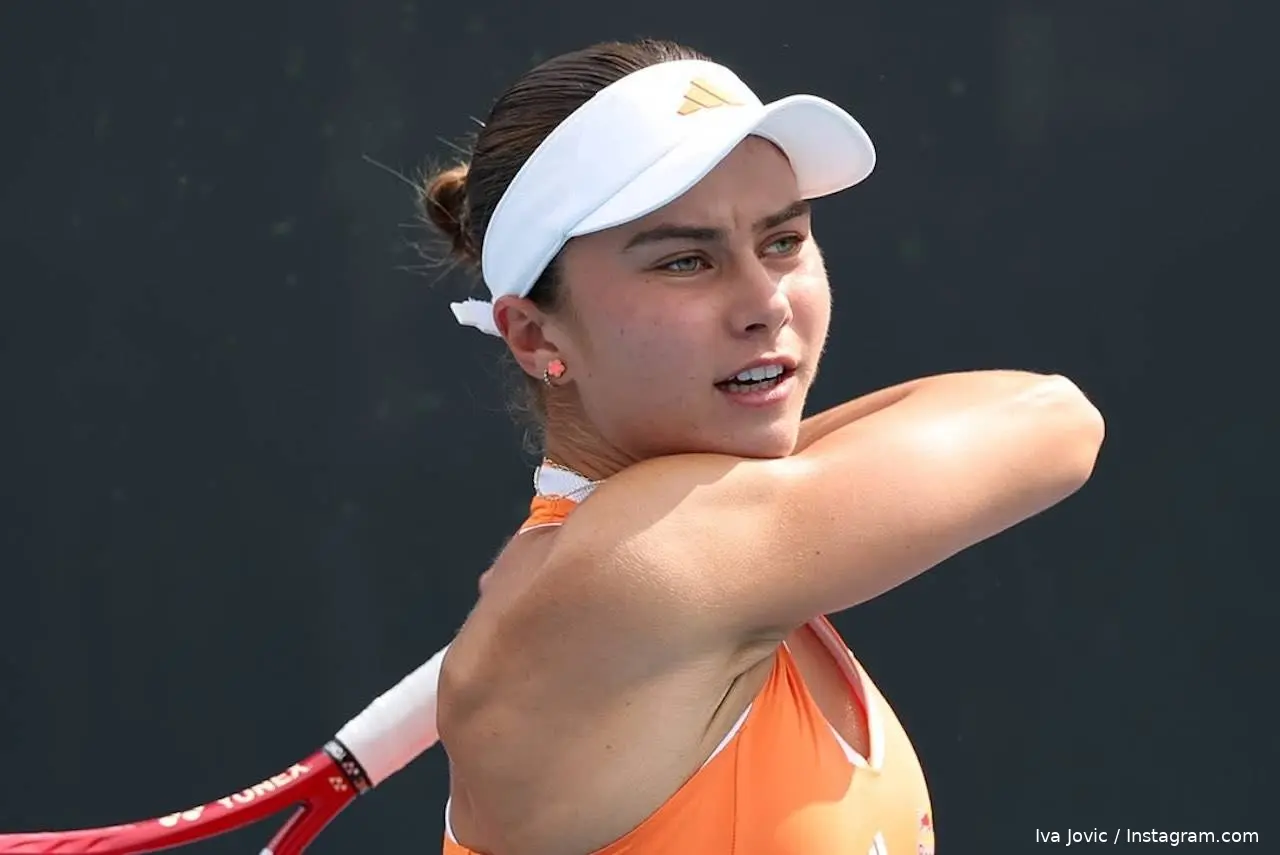
Iva Jovic had never played on clay as a child. That detail alone says something about how extraordinary her rise has been. The 18-year-old American reached the quarterfinals of the Australian Open earlier this year and is now ranked 16th in the world.
Yet clay, the surface that defines a large chunk of the professional season, was essentially foreign to her until the age of 13.
"To be honest, I didn't even know what clay was until I was 13," Jovic said at a press conference in Charleston this week.
The admission came after she opened her clay season in convincing fashion, defeating fellow American Alycia Parks 6-3, 6-2 in the first round of the Credit One Charleston Open. It was a performance that suggested her rapid rise on hard courts is not necessarily limited to one surface.
Melbourne Park
A year ago Jovic was not even ranked inside the top 100. Her climb has been one of the most dramatic in women's tennis over the past twelve months. The breakthrough moment came at Melbourne Park in January, where she defeated world number four Jasmine Paolini on her way to the last eight.
She eventually lost to Aryna Sabalenka in the quarterfinals in straight sets, but that result alone was enough to push her inside the top 20.
Sabalenka is the reigning Australian Open champion and one of the best players in the world. The fact that Jovic got that far without looking entirely out of place was a signal to the tour that something real is happening with this teenager.
She was born in 2006 in California and grew up playing primarily on hard courts. Clay remained largely off the radar until her early teens, which makes her first-round win in Charleston even more notable.
Most top players who later excel on clay developed their skills on the surface from a young age. Players like Rafael Nadal built their entire game around it. Jovic had to catch up years of clay experience in a compressed timeframe.
Footwork
Her approach to solving that gap is straightforward. "I have been doing movement training every day. I have not played much on clay in my life but I work on my footwork every day. There is no secret, you just have to do your training," Jovic said.
Footwork is arguably the most critical skill on clay. The surface is slower and the ball bounces higher, which means players need to reset their position between shots constantly.
Hard-court players who transition poorly often struggle not because of their strokes but because their feet are not quick enough to get in position on the sliding surface. Jovic is clearly aware of that and is addressing it directly.
Her coach and support team will be familiar with the challenges ahead. The clay season peaks at Roland Garros in late May and early June, where the draw is full of clay specialists who have spent their entire careers on the surface. Iga Swiatek has won the French Open four times.
Simona Halep built her career there. Even beating one round opponent in Charleston does not mean the Paris draw will be straightforward for a player still learning the nuances of red dirt.
But Jovic herself is not setting a ceiling on what she can achieve. "I think I have not reached my maximum yet. When I was younger I just wanted to play. I dreamed of being good enough to compete at Grand Slam tournaments. So this is already beyond what I expected from myself. But now that I am here I want to see how much more I can improve. There are plenty of opportunities ahead," she said.
That combination of realism and ambition is part of what has impressed observers since her Australian Open run. She does not talk like a player who got lucky in a favourable draw. She talks like someone building toward something bigger.
At 18 years old and already inside the top 20, Jovic has time on her side. If she can develop her clay game to the level where her hard-court results are not an outlier but a consistent baseline, the women's tour may be looking at one of its next major forces. The Charleston tournament will give a clearer picture of where she actually stands on this surface.
Popular News
Just In


Loading