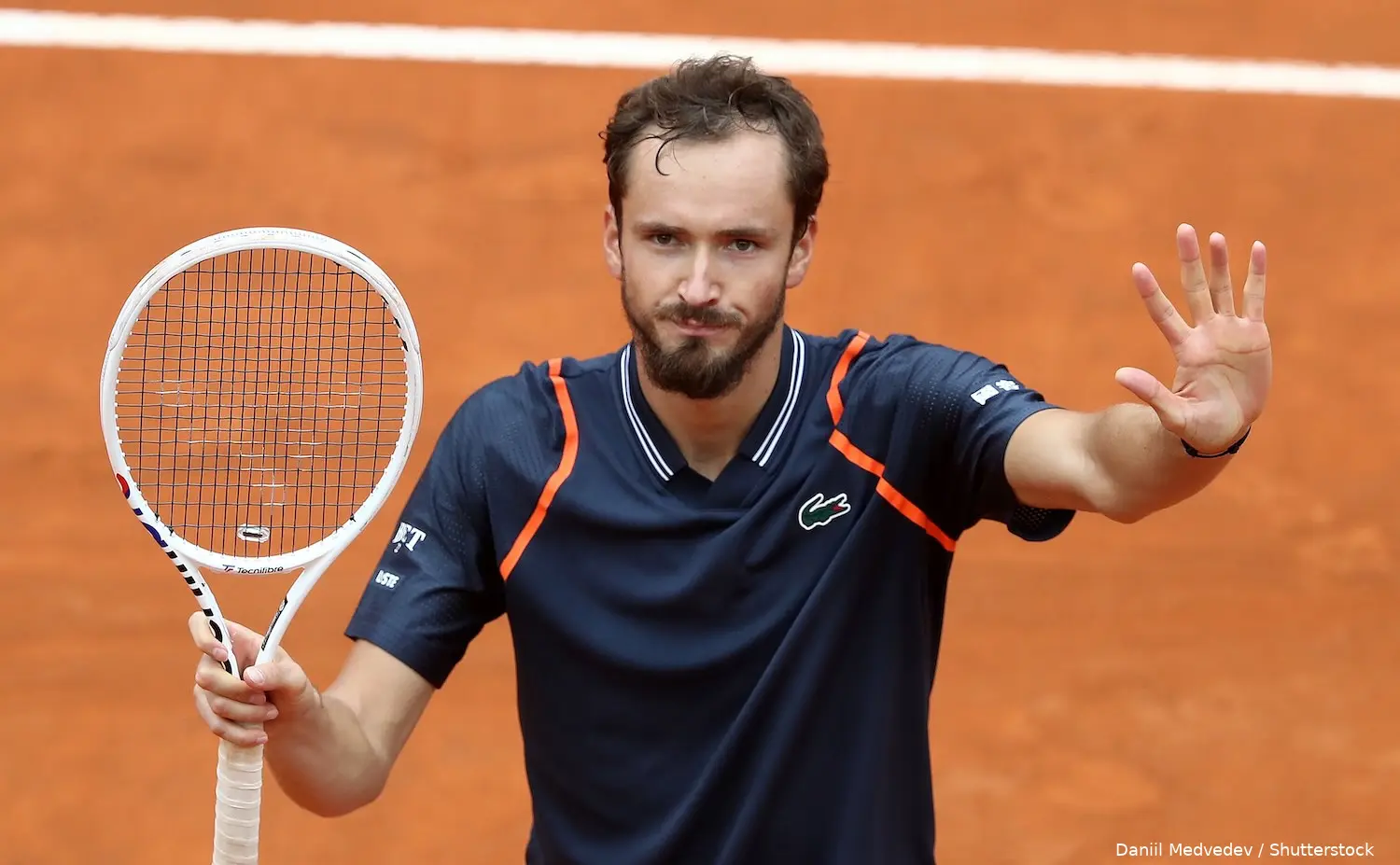
For decades, the blueprint for a tennis world number one looked remarkably similar.
Somewhere between 6-foot-1 and 6-foot-2, light on their feet, clean ball strikers. Then Daniil Medvedev came along at 6-foot-6 and tore up the blueprint entirely, with what former American pro Sam Querrey freely admits was not pretty to watch.
Medvedev holds the distinction of being the tallest player ever to reach the top of the ATP Rankings, a record he claimed during his two spells at number one in 2022 totalling 16 weeks.
Before him, the record belonged to fellow Russian Marat Safin at 6-foot-4, who held the top spot for nine weeks spread across 2001. In the entire history of the ATP Rankings since 1973, only those two men above 6-foot-3 have ever reached number one.
The tallest no. 1 in ATP history
The four longest-tenured number ones in history, Novak Djokovic, Roger Federer, Pete Sampras and Ivan Lendl, all stand between 6-foot-1 and 6-foot-2. Rafael Nadal, Andy Murray, Carlos Alcaraz and current world number one Jannik Sinner cluster in the same range.
Querrey, himself 6-foot-6 and a former world number 11, has long argued that around 6-foot-2 is close to the ideal height in men's tennis.
"That seems to be like the ideal height: you're tall enough to get good pop and angles on the serve, yet you're short enough that your movement can be perfect," he told ATPTour.com.
"And you're maybe less injury-prone."
"That ugly game he has"
Yet Querrey is also among the first to acknowledge that Medvedev built something genuinely unusual. Speaking about the Russian's path to the top of the game, Querrey was candid in his admiration, even if the compliment came wrapped in an unflattering label.
"He was a great returner. He hit an awkward ball; it was hard to attack against him. He was tall but played great defense for a tall guy," Querrey said. "He kind of perfected that, I hate to say, that ugly game that he has. I feel like he put people in really uncomfortable rallies time and time again."
The description is accurate. Medvedev built his game not around power or beauty, but around disruption. His low, flat strokes sit awkwardly in the strike zone for most opponents.
His returns land deep and heavy. His defensive retrieval, remarkable for a man his size, turned would-be winners into starting points for new rallies.
Where conventional wisdom said tall players won by serving their way out of trouble, Medvedev thrived by dragging opponents into exactly the kind of grinding baseline exchanges that big servers typically avoid.
"His serve was just good," Querrey noted, not great, not dominant. For a 6-foot-6 player, that is almost a contrarian observation. Most players of that height live and die by their serve. Medvedev's serve was a supporting act in a much more complete production.
A new archetype taking shape
Medvedev's rise to number one has prompted a broader rethink of what is possible for taller players. Querrey acknowledges the game is trending in that direction, even if he remains cautious about declaring height an outright advantage.
"In this day and age, the guy who's 6'1" can hit the serve as fast as the guy who's 6'6"," he said. "Everyone can kind of hit a serve 135 miles per hour. Obviously you get better angles the taller you are. But I feel with the game and the movement, how physical it is, the guys at 6'2" are just a little bit better moving around the court than the guys at 6'6"."
That said, he sees movement among the game's taller players improving steadily. "The guys that are around 6'6" now, they're becoming better movers every year. Medvedev, Zverev and Tsitsipas are great movers. I just don't think they're as good as tennis players as Alcaraz and Sinner."
There remains, in Querrey's view, something about the slightly shorter elite player that produces cleaner ball striking. "There's just something about the 6'2", 6'3" guy that seems to catch the ball a little cleaner every time when they're hitting it."
Whether that gap will continue to shrink is one of the more interesting structural questions in the sport. Asked whether the next record-breaking number one will be taller than Medvedev or shorter than the 5-foot-9 Marcelo Rios, the shortest number one in ATP history, Querrey did not hesitate.
"I would bet anything that it's going to be taller. It has to be!"
Popular News
Just In



Loading